Most security teams are still operating with the wrong mental model for AI.
They are applying traditional software supply chain thinking to a system that no longer behaves like traditional software.
In the old world, you worried about source code, dependencies, build systems, containers, signing keys, and the people who could push to production. That world still matters. But AI expands the trust boundary in ways most organizations have not fully internalized yet.
Now you are trusting models you did not build, data you did not fully curate, prompts that shape runtime behavior, and agents that can take action on your behalf. That means your supply chain is no longer just code. It is code, models, datasets, prompts, tools, and autonomous behavior.
This is why AI supply chain security is becoming one of the most important problems in modern engineering.
The teams that get ahead of it will not do so by adding another dashboard. They will do it by changing how they think about trust, control, detection, and response.
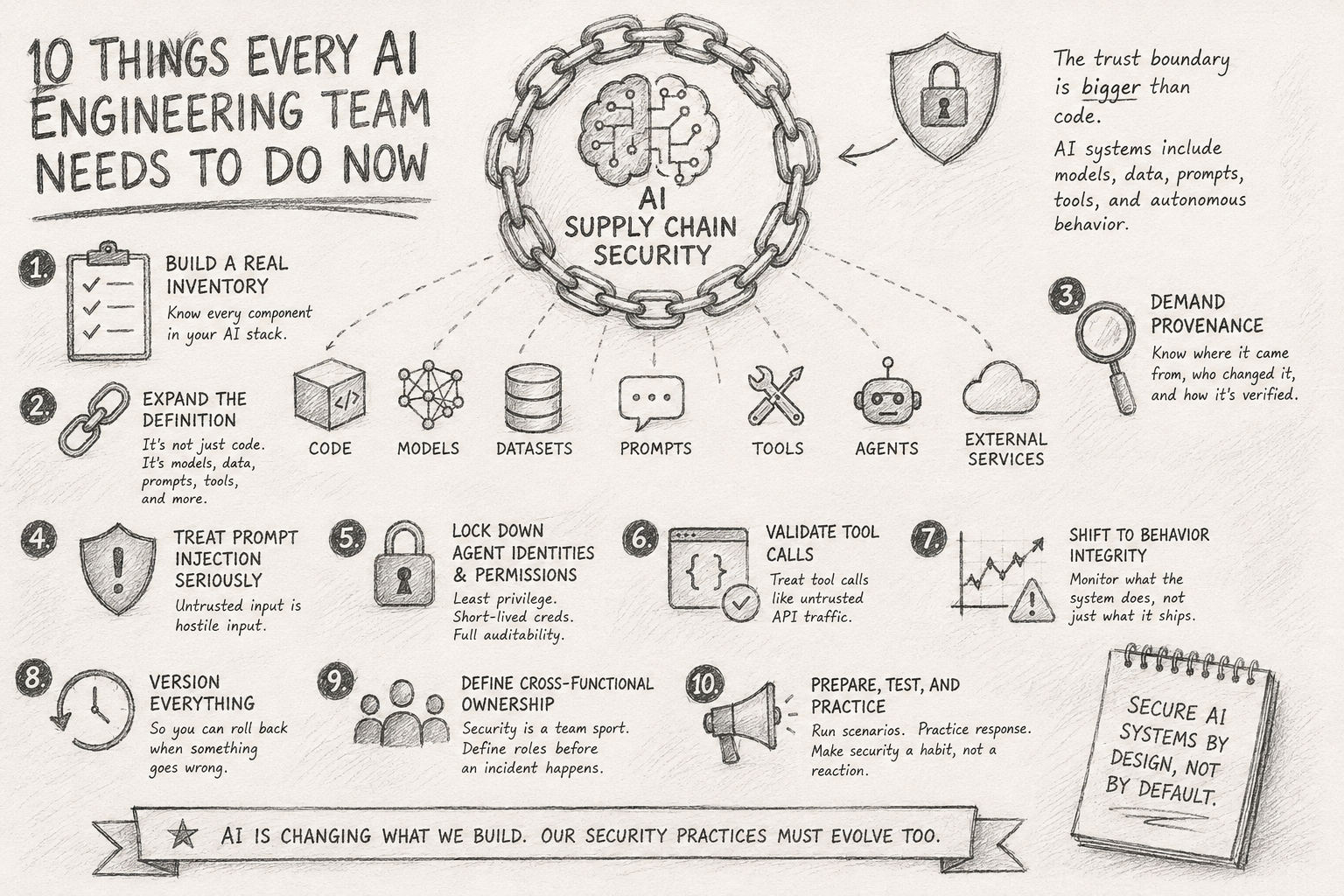
Here are the ten things every AI engineering team needs to do now.
1. Build a real inventory of your AI stack
The biggest gap in most organizations is not protection. It is visibility.
Most teams cannot answer a basic question with confidence: what AI components are actually running in production today?
That inventory needs to include:
- Foundation models from third-party providers
- Fine-tuned internal models
- Training and evaluation datasets
- Prompt templates and system prompts
- Retrieval and RAG content sources
- Agent frameworks and tool integrations
- ML libraries, tokenizers, and serving dependencies
- External APIs, plugins, and embedded SDKs
If you do not have an inventory, you do not have a security program. You have a hope-based strategy.
2. Expand the definition of the supply chain
Traditional supply chain security focused on what gets compiled and shipped.
AI changes that. In an AI system, runtime behavior is influenced by many components that never look like source code:
- Model weights
- Fine-tuning artifacts
- Datasets
- Prompt logic
- Tool definitions
- Agent policies
- External inference providers
If it can change what the system says, decides, or does, it is part of the supply chain.
That is the mindset shift teams need to make quickly.
3. Demand provenance, not just performance
A model can benchmark well and still be a security liability.
For every important AI component, your team should be able to answer:
- Where did this come from?
- Who published or trained it?
- What changed in the latest version?
- How is integrity verified?
- What data was used?
- Who approved it for production use?
Most teams today can answer one or two of those questions. Mature teams can answer all of them.
Performance gets a model in the door. Provenance determines whether it belongs in production.
4. Treat prompt injection as a serious security boundary
Prompt injection is not a quirky LLM issue. It is one of the defining attack classes of AI systems.
Once a model can read untrusted content and call tools, prompt injection becomes operationally dangerous. The model can be manipulated into:
- Revealing sensitive context
- Calling the wrong tools
- Ignoring policy
- Producing misleading summaries
- Escalating attacker-controlled instructions
The correct mental model is simple: prompt injection is command injection for AI systems.
That means untrusted text must be treated like hostile input, not harmless context.
5. Lock down agent identities and permissions
An agent should be treated like an autonomous service account, not a magical assistant.
If it has access to internal systems, tickets, code, or cloud infrastructure, it needs the same controls you would apply to any privileged identity:
- Scoped permissions
- Short-lived credentials
- Action limits
- Approval gates for writes
- Full auditability
- Clear ownership
The most dangerous agent is not the most capable one. It is the one with broad permissions and weak boundaries.
6. Validate tool calls like untrusted API traffic
The model is not the only risk. The tool layer is where risk turns into action.
Every tool boundary should be treated like an untrusted API surface:
- Validate inputs
- Enforce schemas
- Reject dangerous parameter combinations
- Constrain data exposure
- Validate outputs before passing them back into the model
- Log requests and results
The system should never assume that because a tool call came from an internal agent, it is safe.
That assumption will fail.
7. Shift detection from code integrity to behavior integrity
Traditional supply chain security asks whether the artifact was tampered with.
AI systems require another question: is the behavior changing in ways it should not?
Security teams need visibility into:
- Unexpected tool usage
- Abnormal prompt patterns
- Output anomalies
- Hallucination spikes
- Policy violations
- Data drift
- New or unexplained model behavior after updates
This is a major operational change. You are no longer only protecting what got shipped. You are monitoring what the system is doing in the world.
8. Version everything so rollback is possible
When an AI component is compromised, rollback is not optional. It is the recovery path.
That only works if you have disciplined versioning for:
- Model weights
- Model configs
- Fine-tuned variants
- Prompt templates
- Dataset snapshots
- Retrieval corpora
- Evaluation suites
- Dependencies
If you cannot restore the previous known-good state across all of those layers, incident response becomes improvisation.
And improvisation is where small incidents turn into major failures.
9. Define clear cross-functional ownership before an incident
AI supply chain incidents do not belong neatly to one team.
They touch:
- Application security
- AI or ML platform teams
- Security operations
- Engineering leadership
- Sometimes legal, compliance, and vendor management
That means ownership cannot be vague.
A practical model is:
- AppSec owns supply chain integrity controls
- ML or AI platform owns model and data lineage
- SecOps owns monitoring and incident response
- Engineering leadership owns trust boundaries and production policy
Most importantly, every incident needs a single decision-maker. Without that, response degrades into coordination theater.
10. Design trust boundaries explicitly
The most mature AI teams do not ask, “Do we trust this system?”
They ask, “What is this system trusted to do, and what is it not trusted to do?”
That is the right framing.
Not every model should have access to internal documents. Not every agent should be allowed to write tickets. Not every retrieval source should be treated as trustworthy. Not every external provider should be able to influence a production workflow without a control layer in front of it.
Trust has to be granular, explicit, and enforced.
That means:
- Classifying AI components by trust tier
- Limiting downstream actions based on trust
- Isolating sensitive systems from low-trust components
- Requiring approval for high-risk operations
- Designing as if compromise will happen
Because eventually, it will.
What a strong program looks like
If you want the shortest possible version of the playbook, it is this:
Visibility. Control. Monitoring. Resilience. Governance.
Know what you have. Limit what it can do. Watch how it behaves. Make rollback fast. Define who owns what.
That is the foundation of AI supply chain security.
Final thought
AI is forcing engineering teams to confront a deeper truth: modern systems are no longer just built from code. They are built from layers of delegated trust.
You are trusting external model providers. You are trusting datasets. You are trusting prompts and tools and agents and evaluation pipelines. Each of those layers can become an attack surface. Each of those layers can become a control point.
The winners in this next phase will not be the companies with the most AI. They will be the ones that know exactly what they are trusting, why they are trusting it, and how they will respond when that trust breaks.