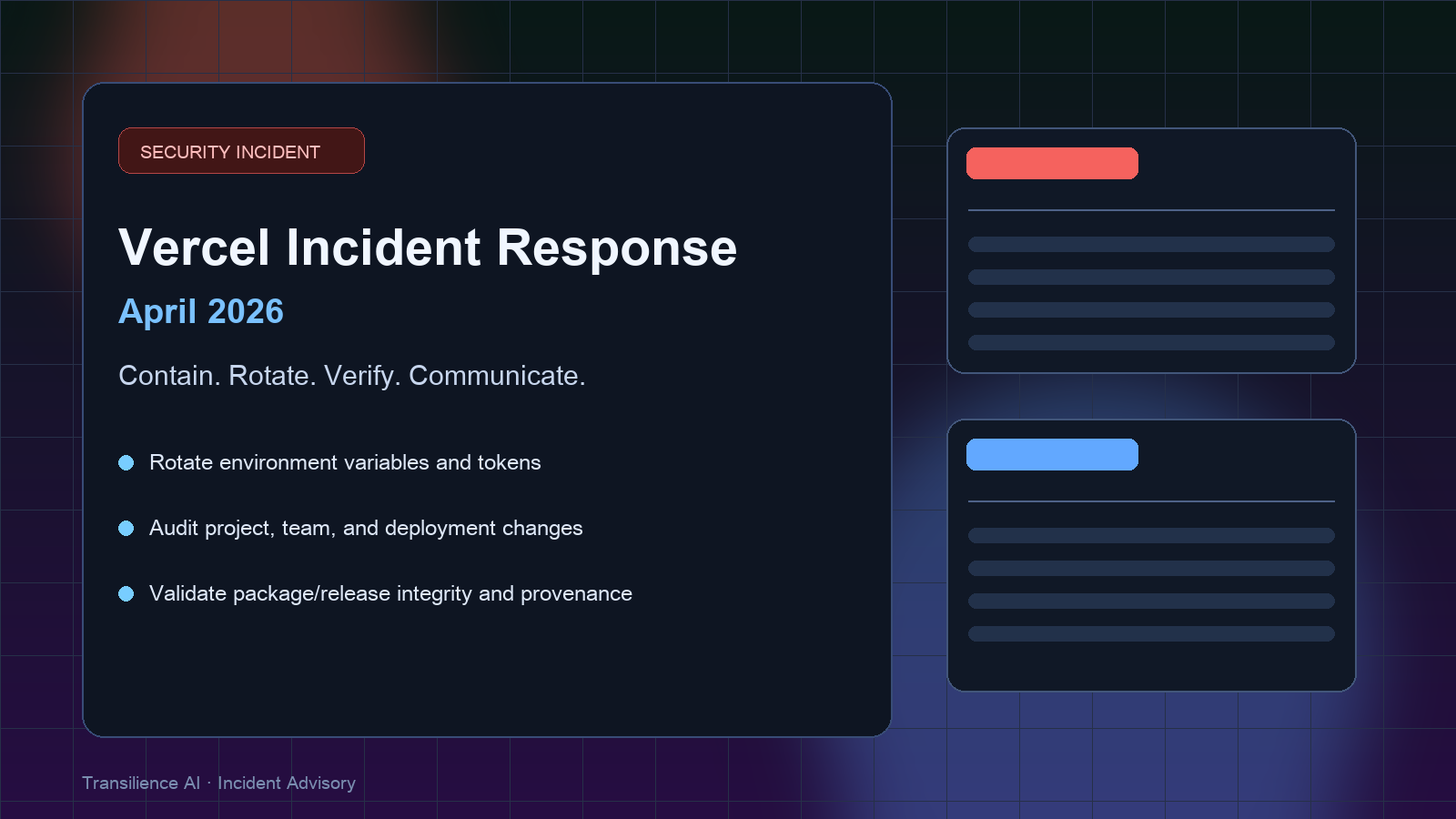
On April 19, 2026, Vercel publicly disclosed unauthorized access to certain internal systems.
This post focuses on three things:
- What is confirmed right now
- What is still unknown
- What teams using Vercel should do immediately
What Is Confirmed
As of April 19, 2026, the following points are publicly reported:
- Vercel disclosed an active security incident and stated that a limited subset of customers is impacted.
- A BreachForums actor using the ShinyHunters handle is reportedly offering data claimed to be from Vercel systems.
- Public commentary from Theo Browne indicates Linear and GitHub were primary compromised surfaces, and that environment variables marked as sensitive are not exposed in the same way as non-sensitive values.
What Is Not Confirmed Yet
These are still open:
- Initial access vector
- Exact intrusion start date
- Exact number of impacted customers
- Full data inventory and data volume
- Independent validation of the full breach-sale dataset
Treat this as an active incident with partial disclosure, not a closed postmortem.
Why This Matters for Vercel Customers
The highest operational risk is token and secret exposure through integration paths and non-sensitive environment variables.
Even if no direct compromise is visible yet, the blast radius can include:
- Cloud credentials and database credentials
- Third-party API keys
- CI/CD and package publishing tokens
- SCM integration tokens
Immediate Actions (Today)
1) Rotate Environment Variables
Prioritize rotation for variables not marked sensitive:
- Database credentials
- JWT/signing secrets
- API keys (payments, messaging, AI providers, email)
- OAuth client secrets
2) Rotate Integration Credentials
Re-issue credentials tied to deployment and source integrations:
- GitHub/GitLab/Bitbucket integration tokens
- Deploy hooks and automation keys
- Build-time service tokens
3) Rotate Package Publishing Credentials
If releases are automated through CI/CD:
- Rotate npm publish tokens
- Enforce 2FA where supported
- Review recent package publish history for anomalies
4) Review Team and Project Audit Trails
Check for unauthorized changes since at least March 2026:
- New team members
- New projects
- New environment variables
- New deploy hooks or changed build settings
5) Monitor for Targeted Follow-Up
Expect phishing and impersonation attempts framed as incident updates.
Validate all “urgent action” requests through official channels and known account-owner email paths.
Operational Monitoring for the Next 72 Hours
- Track official Vercel updates and timestamps
- Monitor threat-intel feeds for newly published IOCs tied to this incident
- Watch for credential abuse in cloud and SCM logs
- Alert on new auth patterns from unusual geographies or user agents
Practical Response Priority
If team bandwidth is limited, execute in this order:
- Secrets rotation
- Integration token rotation
- Audit-log review
- IOC and abuse monitoring
This sequence reduces immediate attacker value fastest.
Final Take
This incident should be handled as a live containment and credential-hardening event.
Do not wait for a full root-cause report before rotating secrets and re-issuing integration credentials.
Speed matters more than narrative completeness in the first response window.