Security work has traditionally rewarded people who can hold the entire system in their head: logs, query languages, alert pipelines, framework mappings, and remediation runbooks.
That is changing.
Vibe security: logic over mechanics
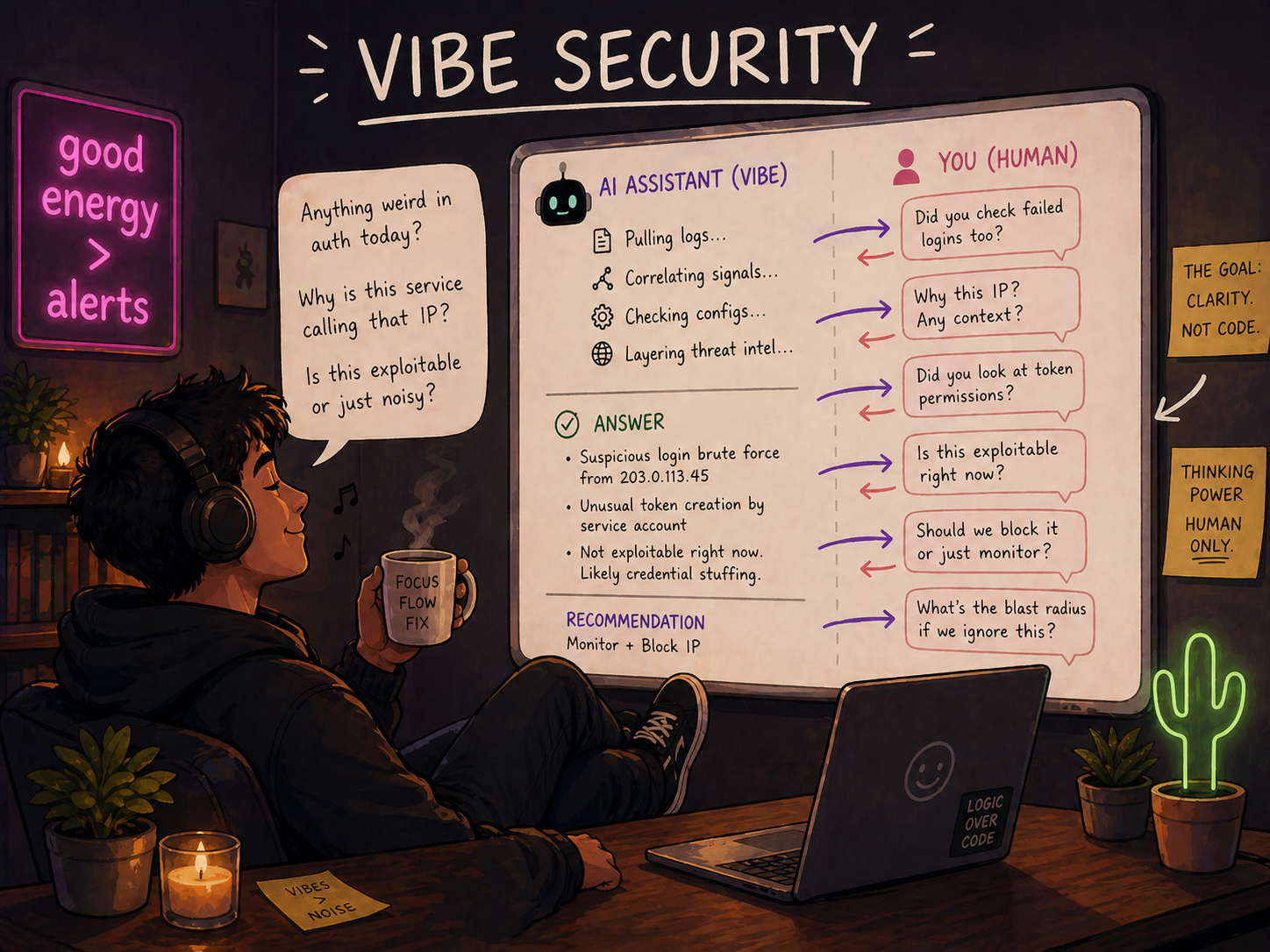
"Vibe security" is what happens when you stop writing the glue, stop caring about the mechanics, and start guiding the logic.
You do not hunt through logs or trace execution paths manually. You ask:
- "Anything weird in auth today?"
- "Why is this service calling that IP?"
- "Is this exploitable or just noisy?"
The LLM goes off, pulls logs, correlates signals, checks configs, layers in threat intel, and comes back with a take.
You are not writing detections, you are nudging them into existence.
You are not triaging alerts, you are compressing them into decisions: ignore, fix, contain.
Vulnerabilities turn into "does this matter right now?" instead of deep CVE analysis.
Why the code matters less than the skill
The code the LLM writes along the way is throwaway code.
Maybe it writes a query, a script, a parser, a quick correlation, or a one-off enrichment step. That code does not need to be clean, and it does not need to survive the day.
The point is not the code.
The point is the logic that emerges while getting to the answer.
If, working together, you land on a better way to recognize a misconfiguration, connect two signals, prioritize a finding, or explain why something matters, that logic gets folded back into the skill.
The code disappears. The skill compounds.
How the workflow really feels
When something breaks, you paste the error and ask again.
Maybe you rephrase. Maybe you try a different angle until it works.
The mechanics, queries, code, and pipelines are not really "there" in any durable sense. They are ephemeral, spun up to get an answer and then gone.
It becomes less about understanding every detail and more about driving toward the right outcome.
Fast, slightly opaque, sometimes messy, but often good enough, and occasionally uncannily effective.
Where this model works best
This style works best at the leaf nodes of security, not the trunk nodes.
It is excellent for:
- signal correlation
- noisy alert compression
- vulnerability relevance checks
- contextual investigation
It is weaker for:
- remediation ownership across teams
- long-horizon security strategy
- organizational risk governance
In other words: vibe security is strongest where decisions are local, bounded, and frequent. It is less reliable where decisions are political, cross-functional, and durable, the territory where a Security OS carries more of the weight.
So, what is vibe security now?
Vibe security is no longer just a tooling problem or a visibility problem.
It is becoming a decision velocity problem.
The teams that win will not be the ones who write the most glue code.
They will be the teams that turn raw security noise into clear decisions, faster than everyone else.