As Arthur C. Clarke said, any sufficiently advanced technology is indistinguishable from magic. The time for Cloud Security to feel that magic has come. Imagine a cloud environment that notices a misconfiguration on its own, figures out what it touches, drafts the fix, applies it, watches what happens after, and only pulls in a human when it runs into something it isn't authorised to decide. Ten years ago that would have read as fantasy. Today it's the assumption a credible cloud security system has to be built around.
It is called a Security OS. It's the third era of cloud security, and the thing that separates it from everything that came before is straightforward: it runs the operation. The human doesn't drive it through a queue of alerts. It drives itself, and it only comes to you when it actually needs you.
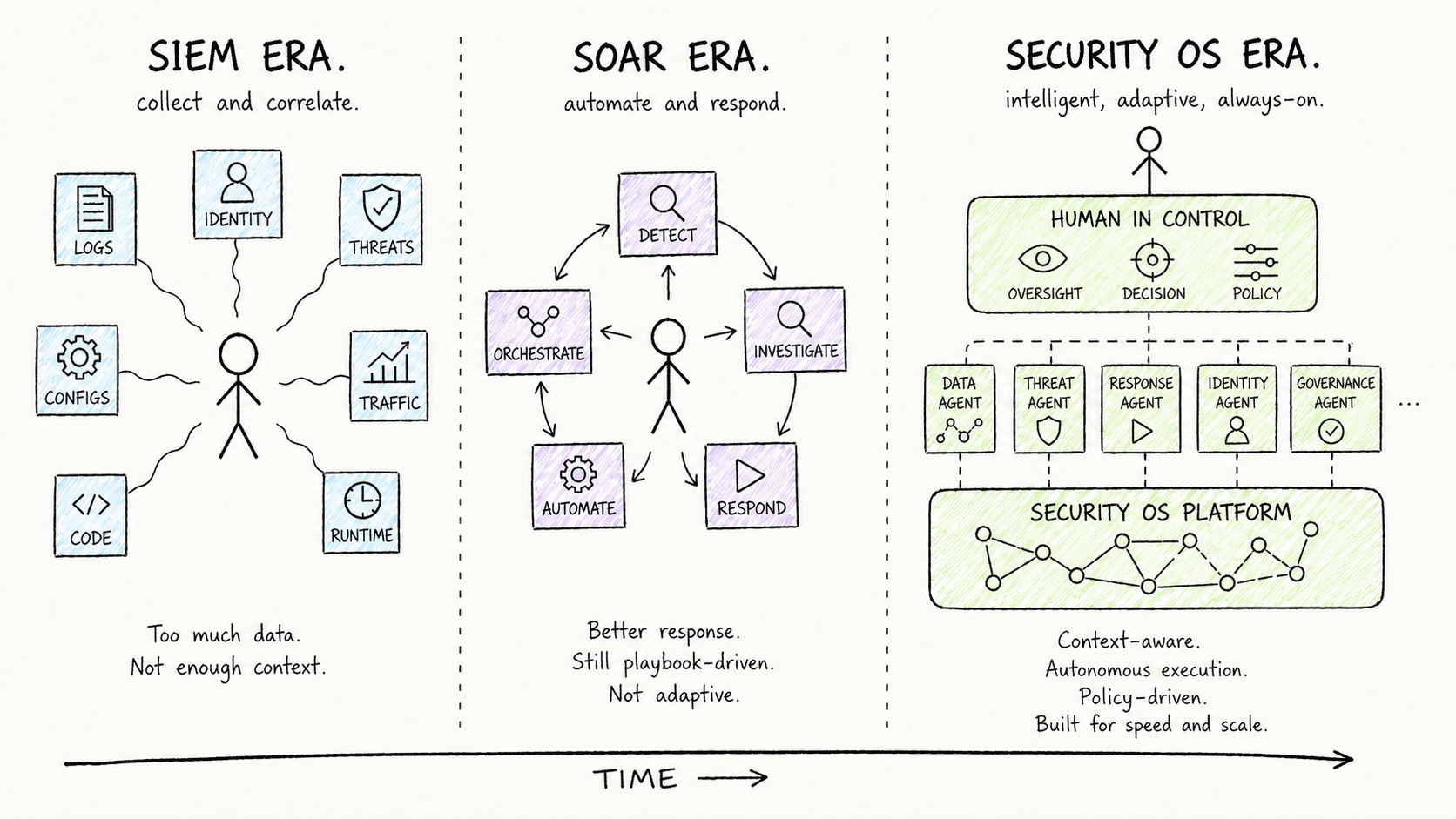
The two eras before it
Era one. The log and dashboard era.
Cloud security was a discipline of rules enforced by tools- CSPM scanning configurations against fixed checklists, SIEMs hunting for log patterns that had been catalogued ahead of time etc. Compliance was still a spreadsheet exercise where you mapped controls to evidence and waited for the auditor review. The intelligence lived inside rules that humans wrote in advance, which meant somebody had to anticipate every case worth catching.
That setup worked fine when environments were small, but as most enterprises moved their workloads to cloud, it didn't anymore. Cloud surface area grew faster than the rule-writing could keep up with, and you ended up with a familiar picture: thousands of unaddressed findings sitting in a queue, an analyst slowly working through them and the gap between detection and remediation stretching out indefinitely. The tools weren't really the problem but the underlying framework was. Neither the system of pre-written rules can be scaled against a surface that's growing combinatorially nor the person sitting at the center of it.
Era two. The rule and orchestration baed era
CSPMs got summary panels. SOC consoles got copilots that could draft an investigation plan. SOAR playbooks got an LLM step inserted somewhere in the triage path.
What followed was a credibility cycle the industry is still working through. The copilots are helping with the margins but they are not reshaping how the operation actually runs. The deeper issue is that who is running things is not changing. The analyst still opened the alert, still decided what it meant, decided what to do, still did it, still confirmed afterwards. LLMs made some of those steps faster. They didn't remove any of the steps and they didn't take ownership of any of them either. A faster human is still the bottleneck, and the bottleneck is still where the failure happens.
If you've been running a cloud security program in 2026, you already know how this plays out. You end up with a stack of products, each with its own LLM features, none of which share an end to end context of the environment, all of which surface their own alerts to your team independently. Your analysts become full-time integrators, spending most of the day pulling signals out of one tool, running them past another, correlating in a third, and then writing the actual decision into a ticket somewhere. What we need is not yet another tool, we need an underlying layer that ties the ones we already have together. It is called cognitive overload, and the reason it can't be fixed by hiring more analysts or paying for nicer dashboards is that the structure underneath the experience is wrong. Era one's rule-based stack didn't go away in this period. It just got a chatbot attached to every component of it.
What LLMs have genuinely solved in this period is knowledge work. What nobody solved is the last mile, knowing what to do is one problem, but continuously doing it at scale, against your specific environment, with your specific risk tolerances, while attackers are running their own agent loops against you in real time, is a different problem.
Era three. The Security OS era. Now.
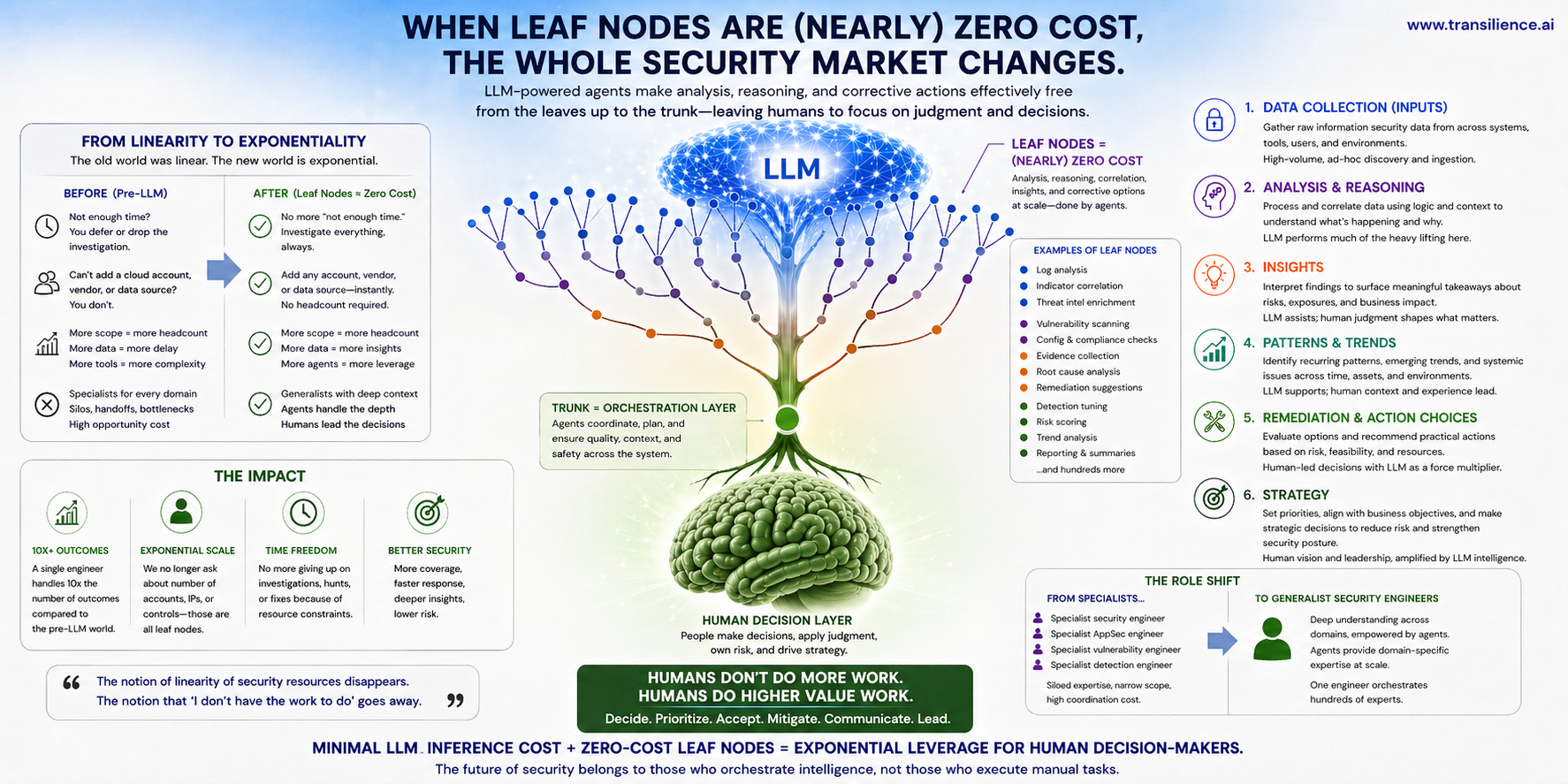
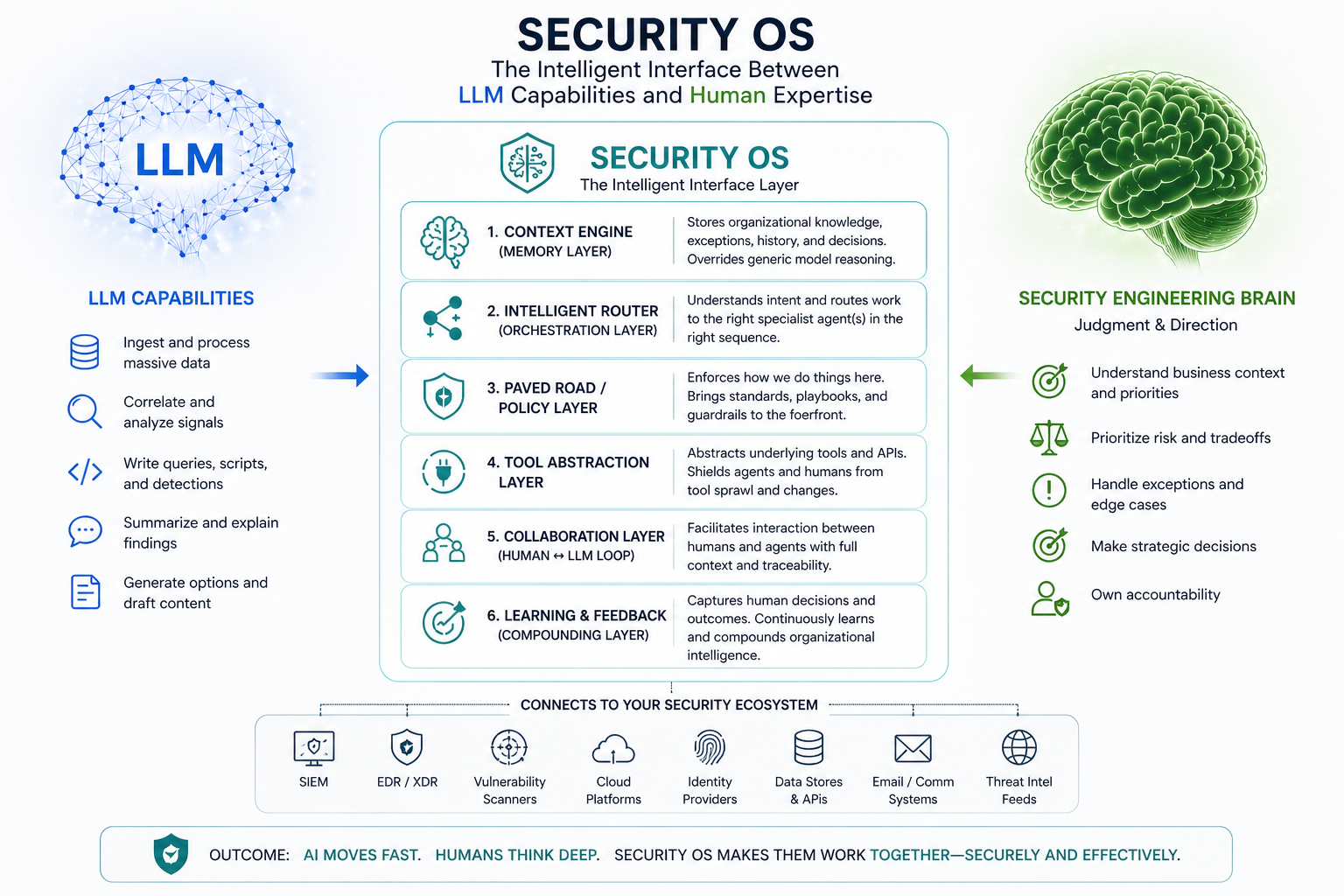
A Security OS is not another tool with LLM features. It's the layer underneath the tools, the place where the operator role finally moves out of the human seat.
Concretely, the OS holds a continuously updated context of the environment and can link the context and drive actions autonomously with proper reasoning. It runs detection, triage, root cause, remediation, evidence collection, and reporting as one connected operation rather than five disconnected ones. Things it's allowed to fix, it fixes. Things it isn't, it stops there and brings in front of the human in the loop (HITL) to do the action or get the context and continues from there. The end state of the loop is not Detected, which is where era one and era two leave you, the end state is Eliminated, and the human only had to step in for the calls that genuinely required a person.
The inversion sounds smaller written out than it is in practice - the software runs the operation and you help when it asks. That single change cascades through everything else.
The closest historical parallel is what an operating system did for general computing. Before operating systems, every program had to handle its own memory, its own I/O, its own scheduling, all of it. Once an OS existed, applications sat on a shared substrate that handled those concerns once and well. Two consequences came out of that, and both of them apply here. A person could use the system without understanding every layer underneath, and anyone with a real need could extend the system by writing their own application on top of it. A Security OS preserves both of those. A team can adopt one without becoming experts on every underlying tool, and the teams that want to push further can build their own apps for their own workflows on top of the substrate.