A question that is thrown at every founder is how will your product compete with the big boys? Why your product versus Google, Anthropic, Palo Alto Networks, Crowdstrike. This contrasts perfectly with these same big companies being on a relentless acquisition spree of the very startups whose existence is being questioned.
Far be it for me to claim that what we are building is better than what the big boys are offering. But it does beg the question: why build at all?
Paraphrasing Marty Cagan from Inspired:
New and disruptive technologies allow us to solve long-standing problems in ways we could not have imagined before.
And here's KK's corollary to this:
New and disruptive technologies also create new problems we could not have imagined before.
We are blessed that no one looked at urban transportation in the 1930s and said, "Hey, Henry's solved it, let's go look for something else to do." Humans have sought innovative ways of solving age-old problems all the time.
And this brings me to the debate of AI-native vs AI-enabled. LLM-centered applications bring to the fore some distinct advantages over just slapping a chatbot onto an existing product.
Here are a few.
Architectural differences
Traditional security platforms surface data for humans to interpret: collect, alert, dashboard, triage, investigate, remediate. Every step assumes a skilled analyst in the loop. AI-native inverts this. The AI reasons, investigates, and acts, surfacing only what requires human judgment, with its logic transparent and auditable.
Faster development
Especially since November 2025, developing new capabilities has become ridiculously easy. At Transilience, we started by automating evidence collection and validation for our compliance customers. And very quickly we ended up building the entire cloud security chain: CSPM, CIEM, CWPP, CNAPP, CTEM. The entire alphabet soup collapsed into agents and Skills. And now we are racing ahead to develop modules for AI Security and Governance, Data Privacy and Protection, and even TPRM.
Flexible UI (and even UX)
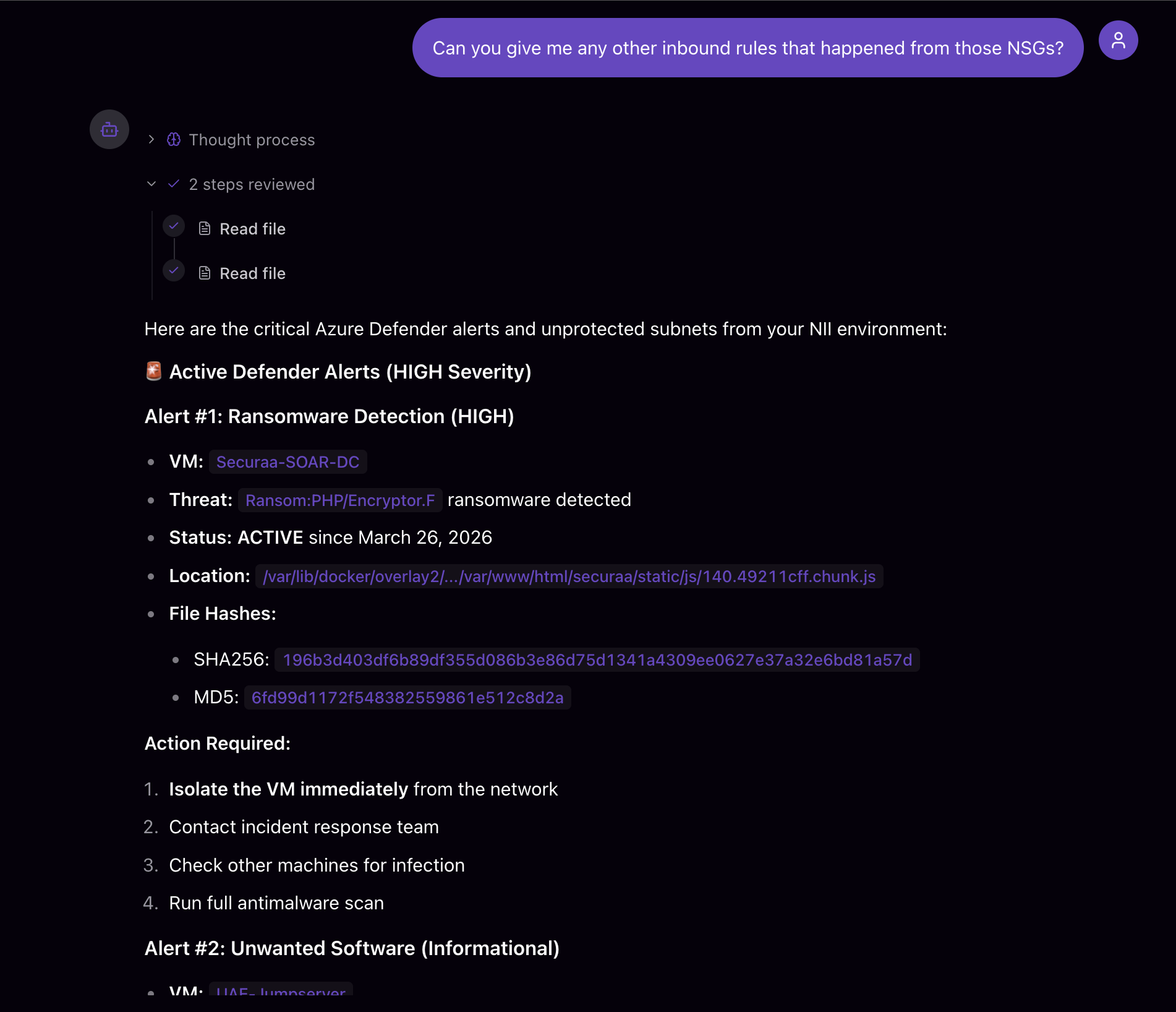
Users can interact with AI-native products as chatbots, MCPs, or custom dashboards and reports. We (and I am sure most other AI-native products) enable users to simply vibe their requests. Even simple things like, "change this bar graph to a pie chart."
Win for Customers
You may argue this is all good for the software engineering folks. But here is how customers benefit.
For companies without large security teams. Enterprise platforms like Wiz assume you have staff to operate them. Visibility is only valuable if someone is looking, and control only matters if someone knows what to do. AI-native means the expertise is in the software. It doesn't just show you a misconfigured S3 bucket, it assesses risk, tells you exactly what to do, and explains why in language appropriate to whoever is reading.
Faster time to value. Traditional platforms require months of configuration, policy tuning, integrations, and training before delivering results. AI-native starts reasoning about your environment immediately. Configuration happens through conversation. Context is learned as you interact.
Democratized access to security expertise. The scarcity in security isn't tools, it's expertise. There aren't enough skilled professionals to staff every company that needs them. AI-native encodes that expertise into the software. A junior DevOps engineer asking "is this IAM policy safe?" gets a response informed by deep security knowledge, not just a rule check.
Adaptability over rigidity. Pre-AI software is static between releases. Logic coded, workflows fixed, reports templated, customization only at defined extension points. AI-native handles novel queries the designers didn't anticipate, which matters in security where threats evolve faster than traditional product cycles.
What this means for Founders
Thank God nobody told the Wright Brothers that trains had already solved transportation.
Every technology shift creates a window where starting from scratch beats iterating on what exists. The incumbents have distribution, capital, and customers. But they also have architectures, revenue models, and organizational structures built for a world that is changing underneath them.
For founders, this is the window. AI-native isn't a positioning statement. It's a structural advantage. The question isn't whether you can compete with the big boys. It's whether you can build what they can't, fast enough that by the time they catch up, you've already moved.